
Lavender: the scent, the science, the distinction.
Why research on an essential oil should not become a medical promise on an incense label.
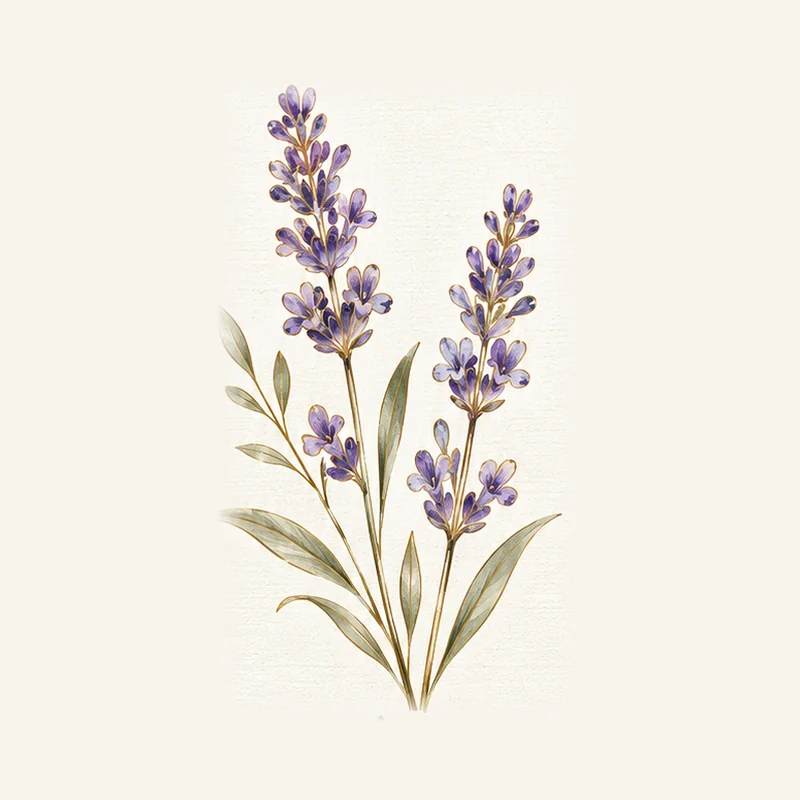
Lavender has a beautiful floral-herbal character. That is a good reason to enjoy its scent. Health claims need a different kind of evidence.
What an essential oil brings to a composition
Essential oils are concentrated plant extracts, obtained by processes such as distillation or mechanical pressing. Their chemical composition varies, and that variation affects their smell. Botanical origin does not make an oil chemically simple or automatically risk-free.[1]
In our Lavender edition, lavender essential oil helps define the aromatic direction. We choose the blend for its recognisable floral-green character and the atmosphere it can accompany. We do not describe a dhoop stick as a delivery system for a medical dose.
A useful study, read in context
A 2015 randomised study involved 79 college students reporting sleep difficulties. Over five nights, both groups followed sleep-hygiene practices; one used a lavender-oil inhalation patch and the other a blank patch. The lavender group reported better sleep quality, but sleep quantity did not differ between groups. The intervention was an oil patch, not burning incense.[2]
This is an interesting result for a defined use, group and duration. It does not answer whether a lavender dhoop stick has the same effect. Product form, concentration, exposure, setting and participant characteristics all affect what a study can establish.
What the broader guidance says
NCCIH says more high-quality research is needed for reliable conclusions about lavender's effectiveness. Its summary describes aromatherapy benefits for anxiety, stress and sleep as unclear, and notes that lavender aromatherapy can cause headache or coughing in some people.[3]
That is why a careful brand can talk about a soft floral atmosphere without saying the product treats anxiety, cures insomnia or improves respiratory health. Those are not interchangeable statements.
A scent cue, not a treatment
There is a gentler way to think about a fragrance-led evening. Put the phone aside. Choose a comfortable chair. Read a few pages or sit quietly. If you enjoy incense and tolerate smoke, a short, attended ritual in a well-ventilated space can become part of that personal routine.
The meaningful part may be the moment you make for yourself. You do not need a medical promise to value it. Equally, a familiar fragrance will not be pleasant to everyone. Personal preference matters, and opting out is always a reasonable choice.
Read floral and woody names carefully
Rose, jasmine, cedarwood and saffron can appear as scent descriptions, ingredient names or both. A fragrance note does not prove that a particular essential oil is present. For example, our Rose has a honeyed, vanilla-like impression; this describes the fragrance rather than declaring honey or vanilla as ingredients.
We distinguish resin-led products from essential-oil blends and identify aromatic materials as specifically as our sourcing supports. An honest composition is more useful than calling every note a pure essential oil.
A practical boundary for evening use
Never leave dhoop burning while you sleep. Place the holder on a stable, heat-resistant surface, away from fabric, keep the room ventilated and extinguish fully before leaving. Incense is a home-fragrance product, not a substitute for support with persistent sleep, anxiety or breathing symptoms.
No cited clinical trial here tested our finished Lavender dhoop sticks. The fragrance descriptions on our collection pages describe the intended sensory experience.
References & further reading
- Essential Oils. Reviewed 19 March 2026.
NIH National Institute of Environmental Health Sciences - Lillehei et al. (2015). Effect of Inhaled Lavender and Sleep Hygiene on Self-Reported Sleep Issues: A Randomized Controlled Trial.
Journal of Alternative and Complementary MedicineDOI: 10.1089/acm.2014.0327 - Lavender: Usefulness and Safety.
NIH National Center for Complementary and Integrative Health
Sources checked on 16 September 2026. Institutional links are provided for independent reading, not to imply endorsement.