

When the resin is part of the stick.
Guggul, botanical materials and the difference between a fragrance name and a formulation.
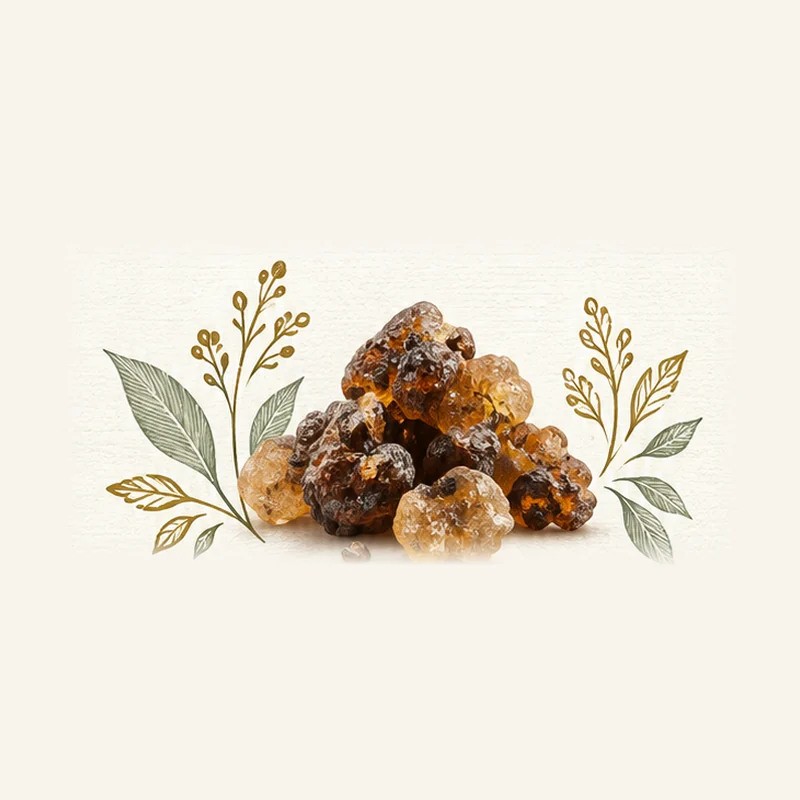
A fragrance can suggest an ingredient. We think it is also worth explaining when that ingredient is physically part of the product.
Guggul begins as a material
Guggul is associated with the gum-resin of Commiphora wightii. The Arid Forest Research Institute describes the plant as a source of this valued oleo-gum-resin and discusses the pressure that over-exploitation places on wild populations. Botanical heritage is therefore also a reason to ask about sourcing, not simply a decorative story.[1]
A resin is not a rock, even though hardened pieces can look stone-like. In our preparation, the hard gum-resin is ground before being incorporated into the base. We call it ground guggul resin rather than inventing a special extraction process.
Our Guggul formulation
Our stated formulation uses more than 30% guggul resin in the base. That proportion describes the base formulation: it is not an essential-oil percentage, an active-compound concentration, a health score or a claim about the percentage of beneficial substances in the smoke.
The point of the decision is straightforward. The ingredient belongs to the body of the stick, not only the name of its scent. Selected wood and herbal powders and the binder system contribute the remaining structure according to the formulation.
Resin, essential oil and fragrance are not synonyms
An essential oil is a concentrated aromatic plant extract. It has its own composition and production method; it is not a general term for every fragrant liquid or all of the material in a resin.[2]
A fragrance name, meanwhile, describes how something is intended to smell. Two products may share a scent name while using different materials. Neither the name nor the colour tells you the full formula. That is why our Guggul and Loban pages describe resin-led compositions rather than adding essential-oil claims automatically.
What to ask before you buy
Ask which resin is used, whether it is included in the base or supplied only as a fragrance impression, and whether the seller can explain the binder and the rest of the formulation. For trade orders, request the current ingredient declaration and the relevant sourcing documentation.
Ask about botanical identity where it matters. Common trade names can vary between suppliers. A photograph of resin pieces is not a substitute for a batch record, and a scientific name should not be added just because it looks reassuring.
Real materials are not a medical shortcut
Our reason for including real resin and wood is ingredient-led craft and fragrance character. We do not claim that inhaling their smoke reproduces the effects of an extract studied in a laboratory, an oral preparation or another form of use.
Likewise, using real material does not mean the product is smoke-free, emission-free or suitable for everyone. We recommend moderate, attended use in a well-ventilated space and clear information about the complete formulation.
A better definition of premium
For us, premium is not simply a louder perfume or a heavier box. It is a set of choices that can be described: which material, why it is present, how the blend is made, and where the claims stop. The packaging should make those choices easier to understand.
The more-than-30% base statement is Dhoopam Atelier's formulation information, not a finding from the cited publications. Research references provide background; they do not certify our sourcing or finished product.
References & further reading
- Commiphora wightii: the source of guggul gum-resin.
Arid Forest Research Institute / Indian Council of Forestry Research and Education - Essential Oils. Reviewed 19 March 2026.
NIH National Institute of Environmental Health Sciences
Sources checked on 16 September 2026. Institutional links are provided for independent reading, not to imply endorsement.